
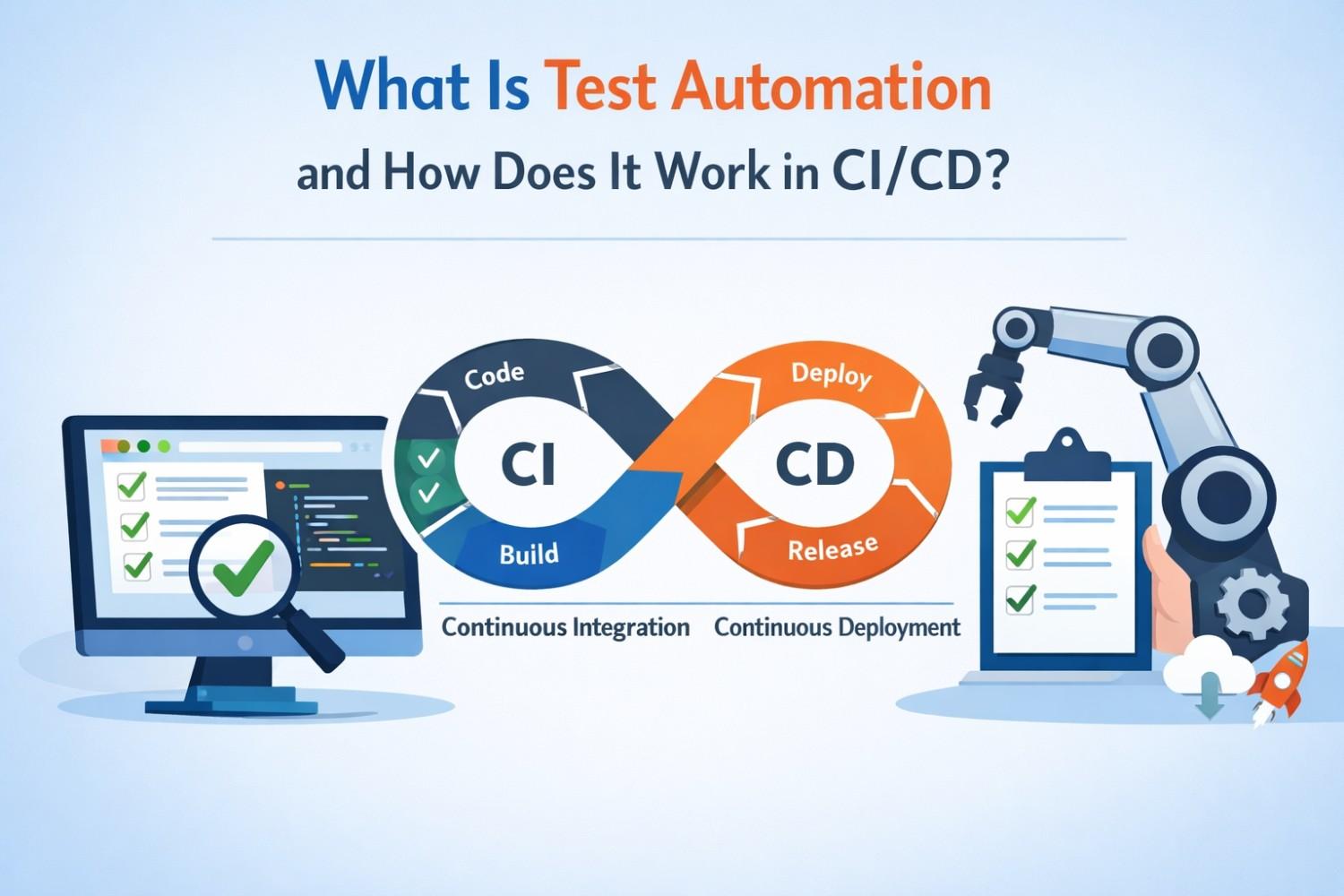
What Is Test Automation and How Does It Work in CI/CD?

Releasing software frequently is no longer optional. Teams push code daily, sometimes hourly. But speed without validation creates risk. Bugs reach production. Features break silently. Fixes consume entire sprints.

This is where the question becomes important: what is test automation, and how does it actually support modern CI/CD pipelines?

Test automation is not just about writing scripts that run automatically. It is about building a system where code changes are validated consistently, repeatedly, and without manual intervention. When done correctly, it becomes the safety net that allows teams to ship faster with confidence.

What Is Test Automation?

What is test automation in simple terms? It is the process of using software to execute tests automatically, compare actual results with expected outcomes, and report failures without human involvement.

Instead of manually clicking through an application or testing APIs one by one, automated tests run predefined checks across different parts of the system. These tests can validate:

  • Business logic

  • API responses

  • Database operations

  • User interface behavior

  • Performance thresholds

  • Security rules

The goal is not to eliminate manual testing entirely. The goal is to automate repetitive, high-volume validation so developers and QA engineers can focus on higher-value problem solving.

Why Test Automation Matters in CI/CD

Continuous Integration and Continuous Delivery depend on rapid feedback. Every time a developer pushes code, the system should verify that nothing critical is broken.

Without automation, this validation would require manual effort, which slows down delivery and introduces human error.

In CI/CD environments, automated tests are triggered automatically when:

  • Code is pushed to a repository

  • A pull request is created

  • A branch is merged

  • A deployment is initiated

This ensures that every change is tested before it reaches production.

When people ask what is test automation in CI/CD, the practical answer is simple. It is the engine that continuously validates software quality as part of the delivery pipeline.

How Test Automation Works Inside a CI/CD Pipeline

To understand how automation fits into CI/CD, it helps to break the process into steps.

1. Code Commit

A developer pushes changes to a shared repository. This action triggers the pipeline.

2. Build Stage

The CI server compiles the code, resolves dependencies, and prepares a testable artifact.

3. Automated Test Execution

This is where automation plays its central role. Different layers of tests may run:

  • Unit tests for individual functions

  • Integration tests for service interactions

  • API tests for endpoint validation

  • End-to-end tests for workflow validation

Tests run automatically without manual initiation.

4. Results and Feedback

If tests pass, the pipeline continues toward deployment. If tests fail, the pipeline stops, and feedback is sent to the team.

This rapid feedback loop reduces the time between writing code and detecting issues. Developers fix problems immediately instead of discovering them weeks later.

Types of Automated Tests in CI/CD

Test automation in CI/CD usually follows a layered approach.

Unit Tests

These validate small pieces of logic. They are fast and run on every commit.

Integration Tests

These check how components interact, such as API to database communication.

API Tests

These validate endpoints without depending on the UI. They are critical for microservices architectures.

End-to-End Tests

These simulate real user journeys. They are slower and often run at later pipeline stages.

Balancing these layers ensures speed without sacrificing coverage.

Choosing the Right Test Automation Tools

When selecting test automation tools, integration is more important than feature count. The tool should fit naturally into your CI pipeline.

Important considerations include:

  • Seamless CI integration

  • Parallel test execution support

  • Clear reporting and logs

  • Maintainability of test scripts

  • Scalability as your codebase grows

Some modern tools reduce manual scripting effort by generating tests from real usage patterns. For example, Keploy captures API calls from real traffic and converts them into automated test cases that can run inside CI pipelines. This approach helps maintain API test coverage with minimal overhead.

The key principle remains the same. The tool must reduce friction, not add complexity.

Common Challenges in CI/CD Automation

Although automation brings speed and consistency, it also introduces challenges.

Flaky Tests

Tests that fail randomly reduce trust in the pipeline. Stable environments and deterministic test data are critical.

Slow Pipelines

Running every test on every commit can slow feedback. Smart test selection and test layering help maintain speed.

Poor Test Design

Automating weak or unclear test cases creates noise instead of value. Test architecture matters as much as execution.

Automation should increase confidence, not frustration.

Measuring the Impact of Test Automation

To understand whether automation is effective, track measurable indicators:

  • Pipeline execution time

  • Test failure rate

  • Deployment frequency

  • Mean time to detect defects

  • Mean time to resolve failures

If automation increases release speed while reducing production incidents, it is working correctly.

The Strategic Value of Test Automation

At its core, what is test automation really about? It is about building confidence into the development process.

Developers can refactor safely. Teams can release smaller changes more frequently. Organizations can scale without multiplying manual QA effort.

Automation transforms quality from a late-stage checkpoint into a continuous validation system.

Final Thoughts

What is test automation, and how does it work in CI/CD? It is the foundation that enables modern software delivery. It runs tests automatically on every change, provides fast feedback, and protects production environments from avoidable failures.

As systems grow more complex and release cycles accelerate, automation becomes less of a luxury and more of a necessity. The teams that invest in well-designed automation today are building pipelines that can scale tomorrow. The real question is not whether automation is required. It is whether your current delivery process can sustain growth without it.

Leave a Reply

Your email address will not be published. Required fields are marked *

Author

lyramarigold06@gmail.com

DoorCart is a modern, innovative brand offering stylish and functional door-mounted carts, designed to maximize space and convenience in your home. Perfect for organizing essentials, DoorCart combines smart design with practicality, making everyday life easier and more efficient.

Related Posts

Examples of successful partnerships for Deputy Department

Examples of successful partnerships for Deputy Department

Partnerships can be the secret sauce to success for many organizations, and Deputy Departments are no exception. As they navigate complex community...

Read out all

The future of partnerships in the Deputy Department

The future of partnerships in the Deputy Department

Partnerships have always played a pivotal role in driving progress within various sectors, and the Deputy Department is no exception. As we...

Read out all

12 Best Translation Services & Localization Companies in 2026

Looking for the best translation services to help your business speak the language of your customers worldwide? You’re in the right place....

Read out all