
You raised your seed round. You turned on ads. Three months later, half your runway is gone and your pipeline looks the same. This is not a fluke. Most seed-stage startups hemorrhage cash on paid channels because nobody taught them how to allocate a small budget under pressure.
This post breaks down where the money actually goes wrong and what a structured alternative looks like.
What Most Founders Get Wrong About Early Ad Spend
The default playbook is simple: pick a channel, set a daily budget, write some copy, and wait. It sounds reasonable. It fails almost every time.
Seed-stage budgets are too small for broad experimentation. You cannot test five channels at $500 each and learn anything meaningful. The data is too thin. The cycles are too slow. You end up with inconclusive results and a depleted bank account.
Worse, most founders optimize for clicks or impressions because those numbers move first. But clicks do not pay salaries. Revenue does.
The real waste is not bad ads. It is spending money before you know what you are measuring and why.
What a Structured Approach Actually Requires
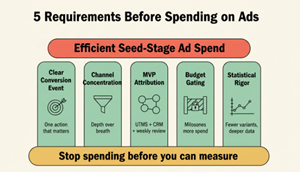
A Clear Conversion Event Before Anything Else
If you cannot define the single action that matters most, you are not ready to spend. For SaaS, that is usually a qualified signup or demo request. For e-commerce, it is a first purchase. Pick one. Optimize everything toward it.
Channel Concentration Over Diversification
At seed stage, you need depth on one or two channels, not surface-level coverage across six. Go deep on the channel where your best customers already spend time. Prove it works. Then expand.
A Minimum Viable Attribution Stack
You do not need a $50K analytics suite. You need UTM parameters, a CRM that tracks source, and a weekly review cadence. If you cannot trace a dollar of spend to a dollar of revenue, stop spending. A marketing agency for startups will set this up in the first week. Most founders skip it entirely.
Budget Gating by Learning Milestones
Never increase spend just because a campaign “looks good.” Set explicit milestones: cost per lead under $X, conversion rate above Y%, payback period under Z months. Hit the gate before you open the wallet.
Creative Testing With Statistical Rigor
Two ad variants are not a test. You need enough volume per variant to reach statistical significance. At small budgets, that means fewer variants tested more deeply, not a dozen half-baked concepts.
Practical Habits That Protect Your Budget
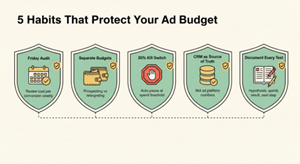
Audit your spend every Friday. Weekly reviews catch waste before it compounds. Look at cost per conversion, not cost per click. Kill anything that has spent 3x your target CPA without converting.
Separate prospecting from retargeting budgets. These serve different functions. Mixing them in one campaign makes it impossible to know what is working. Prospecting finds new audiences. Retargeting converts warm ones. Track them independently.
Set a kill switch at 20% of monthly budget. If any single campaign burns through 20% of your monthly allocation without hitting your conversion gate, pause it. No exceptions. Emotional attachment to a “promising” campaign is how budgets evaporate.
Use your CRM as the source of truth, not the ad platform. Ad platforms over-report conversions by 20-40% on average. Cross-reference every platform-reported lead against your actual pipeline. The gap will shock you. A seasoned marketing agency for startups knows to build reporting from CRM data outward, not the other way around.
Document every test and its outcome. A simple spreadsheet with hypothesis, spend, result, and next step prevents you from repeating failed experiments. Institutional memory matters even at five employees.
The Cost of Getting This Wrong
Startups that waste their seed-stage ad budget do not just lose money. They lose time. And time is the one resource you cannot raise more of.
Your competitors who figured out their unit economics early are now scaling spend with confidence. They know their CAC. They know their payback period. They know which channels produce pipeline and which produce vanity metrics. You are still guessing.
The data is stark. According to CB Insights, 38% of startups fail because they run out of cash. Poor marketing allocation is a leading contributor. A $50K mistake at seed stage is not a learning experience. It is a quarter of your runway.
Every month you spend without a structured approach is a month your competitors use to widen the gap. The startups that survive past Series A are not the ones with the biggest budgets. They are the ones who spent their small budgets with precision.
Author

lyramarigold06@gmail.com
Related Posts

Digital Transformation Trends in Australia 2026
Digital transformation continues to change how Australian organizations operate, compete, and deliver value. In 2026, businesses across industries are increasing investments in...
Read out all
Betanden: The Complete Guide to Understanding Its Meaning and Value
When you first encounter the word betanden, it might sound unusual, unfamiliar, or even mysterious. But like many unique terms in language,...
Read out all
CapCut Mod APK: Safe Installation Guide and Feature Overview
You can get an unlocked version of CapCut that adds premium tools, removes watermarks, and often lets you export in higher quality...
Read out all
picsart mod apk download Guide: Safe Installation and Key Features
You can get a PicsArt Mod APK that unlocks premium filters, AI tools, and removes ads, but you should evaluate sources and...
Read out all
Techsuse: Practical Strategies for Scaling Enterprise Software Quickly
You want a clear sense of what Techsuse is and whether it fits your needs. Techsuse is a technology-focused platform and weekly tech...
Read out all
IPTV Reseller: Why This Market Keeps Expanding
The digital television industry has entered a sustained growth phase driven by broadband expansion, streaming adoption, and consumer demand for flexible subscription...
Read out all